Pages

Wednesday, May 20, 2020

COVID-19 Pandemic Journaling

I am back to share with you the journaling that I have asked of my students during their own time of uncertainty: the 2020 COVID-19 Pandemic.

Continuing to be inspired by the work and tweets of Kelly Gallagher, I assigned my students to begin a journal during our distance learning experience as their warm-up on Mondays, Wednesdays, and Fridays. 

What was assigned?
As their directions, I posted my own COVID-19 journal and continued throughout too. Here's a screenshot of my opening:


I had several students returning to my journal as an example, as "seeds" to begin their own thoughts, and just to see what I was up to. However, just like many of them, I wasn't always consistent, and that's ok.

Why do this? What objectives exist?
This is a piece of my students' personal history. One day, it could even be a primary source!

Journaling is a social-emotional tool. Many students (and adults) benefit being encouraged to share their thoughts through writing.

And if need be, there are writing standards that call for a variety of writing styles, length of writing, and different voices.

How will this be assessed?
We still have instruction this week and will wrap up distance learning next, so I haven't completed this stage yet. However, I did quick "checks" by having students share their journals to show they've started, once counted the number of entries, and done periodic video reminders. I have not read any journal entries unless my students have requested it.

In the end, I have planned a self-assessment through a Google Form that allows them to reflect on their thought, effort, and usefulness of their journaling. This will also be feedback for me as I reflect on how to continue the use of journaling with next year's teaching, whether back in our classroom or distantly.

If you're interested in the feedback I plan to receive, here's the link to a copy of the form: COVID-19 Self-Assessment

What might I change?
In the future, I may intentionally post "seed" prompts for students to help them get started. These could be articles, video clips of speakers or the news, or personal interest prompts.

I'll leave you with what I've been ending posts and conversations with my students:

Stay healthy. Make smart choices. Read a book. 📚

Monday, July 15, 2019

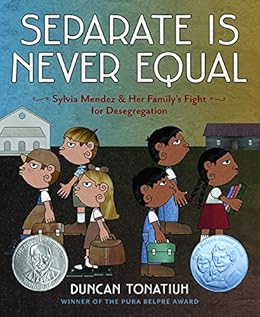
Separate is Never Equal ~ Using Diverse Picture Books

Image result for separate is never equal
Retrieved from Amazon.com
Separate is Never Equal: Sylvia Mendez & Her Family's Fight for Desegregation is a true story written and illustrated by Duncan Tonatiuh. The illustrations incorporate mixed media to enhance the depth of the images. Tonatiuh wrote that the book "is inspired by conversations I had with Sylvia Mendez in October 2012 and April 2013", and he utilized shortened dialogue from court transcripts to share an authentic retelling.

Brown vs. Board of Education of Topeka (1954) is often viewed as the landmark decision by the Supreme Court regarding segregation in public schools; however seven years prior to this Sylvia Mendez's family filed a law suit against Westminster School District of Orange County (California) to challenge remedial schools for Mexican students.

Sylvia Mendez offers this short interview regarding her experiences: 


Sylvia and her family had moved to Westminster, CA for her family to own a farm. As a 3rd grader, she was a US citizen and spoke English, but the closest school to their home would not allow her and her siblings to enroll. Instead, they were directed to a remedial Mexican school that had a less stable building, fewer academic supplies, less qualified teachers, and domestic curriculum. Sylvia's father advocated for his children to attend the school closer to their home by addressing various administrators, but to no avail. Eventually, he was advised to file a lawsuit. Here is a book trailer from Texas Bluebonnet Award:


This story is important to share with students who are learning about the Civil Rights Movement because it adds an additional perspective. Some students have a misconception that the Civil Rights Movement promoted equal rights for only Blacks, but there are also the marginalized voices of those who were considered lower class during that time period: Hispanics, Native Americans, and others. It is also important to share with students that this case would have provided a precedent for the Brown vs. Board of Education of Topeka. In this interview, Tonatiuh also explains that it's important to share this story because even though segregation is not allowed in public schools, there are still divides in education that make this story relevant. By sharing this book with students of all ages, we create an opportunity for students to not only learn a new perspective but also begin a dialogue of where they may see divisions in our education system.

Monday, July 8, 2019

Challenger Deep by Neal Shusterman : A VoiceThread Review

Less than two months ago, I had not heard of Neal Shusterman's novel Challenger Deep. Now I believe it is an important book to share with others! I even talked to my husband about it during our vacation, and he believes it should be made into a movie for others to hear this perspective on mental illness.

Rather than sharing a written review, I was pushed to create my first VoiceThread to review this novel for my critical literacy course. If you take the time to listen, I hope you will be intrigued enough to read Challenger Deep

Feel free to comment on my VoiceThread as well. I'm thinking VoiceThread might be a great way to record discussions for Literature Circles this upcoming year!