Pages

Wednesday, August 10, 2022

Summer Reading: My Top 3 Books (so far!)

I've always got a book that I'm reading. Sometimes two. During the summer months I try to intentionally increase my reading volume to read beside my students, offer book recommendations, and for enjoyment and relaxation. With two toddlers, I try to fit in twenty minutes in the early morning and twenty minutes during nap time, and yet I want more reading time! I'm sure other parents relate. I've read thirteen books (so far) this summer. If you're looking for a read to finish out your summer reading, here are my top 3 to share with students this fall!


Firekeeper's Daughter 

by Angeline Boulley

Firekeeper's Daughter is the fictional story of Daunis Fontaine who has graduated high school and trying to find her place in her community and outside world. She has a love and respect for her Ojibwe culture despite one side of her family resenting her biracial heritage (while still loving her). Daunis makes the decision to remain close to her hometown for her first year of college to support her mom; however, she witnesses a murder that hurts her personally and her community deeply, so she is accepts an undercover role to help her community and understand its loss.

This YAL novel made it so easy to decide what was the most engrossing read of the summer. Absolutely deserving of 5 stars. Here is my initial reaction on Twitter: 

When you pick up this nearly 500-page book, it is deceiving how fast it will be read. The mystery makes it hard to put down. The writing makes it easy to follow along. The intricate details bring it all together. I will share a book talk about this novel with my juniors this fall once my copy of the book is returned to me. 

My favorite part of the book is how complex the characters are and Daunis' acknowledgement of how people are viewed, what motivates them, and learning that we can be wrong (in both good and bad ways). It's truly a story about the strength of people, especially the Ojibwe culture.


Restart 

by Gordon Korman

Restart is the most relatable book I've read in a very long-time. It is the story of Chase, an 8th grade football star who has fallen off his roof and his severe concussion has caused amnesia. As he wakes from his four-day coma, he does not recognize his brother or even his mother. He does not remember the thirteen years of his life including his hobbies, friends, school life. He must begin to learn his old life. In his community, he is well-known and so his experience has become town gossip. Chase recognizes that different groups of people respond to his presence in different ways. Some don't even believe that he has amnesia. When he is told to sit out from football for the season, he must find a way to spend his time. Even though everyone else remembers who Chase used to be, does he want to be that person anymore?

This particular novel was recommended to me by the other seventh grade ELA teacher who had it recommended to her by an incoming seventh grader. And now, well this book is now being considered for book clubs for the seventh grade class. Though we haven't met yet to completely decide, this book could be paired with other texts taught in the course such as Freak the Mighty. It could also pair with well-known books such as Wonder or Fish in a Tree. 

This one is also a quick read since the target audience is middle school, but I honestly would recommend this one to other educators and parents too. It allowed me to reflect on how I treat my students, how my own children might respond to me in ten years, and how we treat others. Not only great reflection, but it's also entertaining. There are moments for laughter. There are moments of wonder. There are moments of frustration. Just like life. That's relatable. And the characters are too. If readers don't relate to Chase, they might relate to his friends, old or new, that we meet throughout this book.


Red, White, and Whole

by Rajani LaRocca

Red, White, and Whole is a verse novel that left me in awe as it tells the story of Reha, a daughter of Indian immigrants. Middle school students may recognize her conflicted feelings of trying to fit-in and being American at school while also trying to please her parents and celebrate her Indian heritage. Reha tries to find a way to communicate this to her parents, but before she finds a way, she learns that her mom, Amma, is ill. This changes Reha's perspective and she becomes the daughter her parents have always asked her to be. 

Verse novels that share characters who become so incredibly real amaze me. They do this with limited space on the page in a way that is often lyrical. This one truly does an amazing job of showing readers Reha's internal and social struggles in a way that if students can't relate, they can recognize and hopefully empathize. Readers also get to know her, like her music and tv preferences.

Even though this is a novel intended for middle school students, I see value in sharing it with my juniors as a book talk alongside our unit related to immigration stories. I hope that at least one will pick this story up to see another perspective that is presented beautifully. 

What's up next?

I'm currently reading A Snake Falls to Earth by Darcie Little Badger. My teacher book club is finishing Teaching When the World is on Fire edited by Lisa Delpit. And I need to read my classic book for my friend book club which is Brave New World by Aldous Huxley.

Tuesday, July 26, 2022

Summer Reading: Book Love Foundation

I want to encourage my students to be lifelong learners, especially through reading. Reading allows us to learn new information, build empathy, relax, and so many other benefits. If I am to offer recommendations to my students for any of these reasons, I must continue to be a lifelong reader too.

That's why I joined Book Love Foundation's Summer Book Club for the first time this year, and as I wrap up the last week of this experience, I'm sharing why I plan to do this again!

What is Book Love Foundation?

If you teach ELA, you have probably heard of Penny Kittle who is the founder of this foundation, a teacher, and an author herself. Kittle believes in the power of reading and created The Book Love Foundation to help other teachers to create or enhance their classroom libraries so that there are diverse books for students. Yes, The Book Love Foundation raises money to present grants to teachers to buy book for their classrooms. Even better: It is organized by volunteers! This means every donation goes towards books for students.

Do you want to learn more? Check out the Book Love Foundation website to learn more about the organization, to see how they've impacted classrooms, and more. Their Summer Book Club is their biggest fundraiser to go towards this 

How does Summer Book Club work?

Five weeks. Four books. Daily written discussions. Author and education interviews.

You get access to all of this by joining the Summer Book Club through their website. When you register, you get the ability to choose what grade level of books (high school, middle school, elementary, or all) to receive the books - no shopping on your part! - along with the swag, which this year included a lightweight cooler, notebook, pen, and metal bookmark.

Already have the books? Or want to mix-and-match the grade levels? You can choose to have access to the online content.

Once the Book Club begins, each book typically gets one focused week to be discussed. You can either read the books prior to the week or throughout the week. During that same week, the author has been available for a live session that is later posted for those who weren't able to join at the scheduled time. There are other conversations with teachers, literacy experts, and authors to explore our interests and needs as educators.

This design makes it easy to tailor your Book Club experience to your teaching and your level of commitment for the summer.

The online experience takes place on a less known platform Mighty Network. The benefit of this is to help us be focused on our Book Club without being pulled into the notifications from other social media platforms.

What are the benefits of Summer Book Club?

For my first summer, I chose to receive all grade levels for a couple of reasons: I teach both middle and high school students; I want to increase my picture book collection; I believe in supporting this foundation. Here are three benefits I have experienced in the past four weeks.

Book exposure:

My first benefit is increasing my book exposure. I had only heard of one of the high school choices before registering: Me (Moth) by Amber McBride. This meant that I was exposed to nonfiction (The Other Talk by Brendan Kiely), a graphic novel (Surviving the City by Tasha Spillett and Natasha Donovan), and picture books (We Can: Portraits of Power by Tyler Gordon and Dad Bakes by Katie Yamasaki). 

Some of the books also shared topics that I am not well-read on or did not have text versions appropriate for the readers in my classroom, such as Kiely's book sharing his experiences of white privilege and Spillett's graphic novel that brings attention to Missing and Murdered Indigenous Women while also demonstrating strength and beauty of the indigenous culture. 

We often are suggested books similar to what we have been reading, so it has been good to have these books not only recommended and to have the encouragement of a book club to read them.

Your pace:

The book club is structured for a book a week (or three if you're interested in all three age-levels), but once the book club gets started, you are able to go at your own pace. Some readers have finished reading the books even before the book club began. Some are reading them at the daily pace of the discussions. And there are those who are like me and try to keep the weekly pace but am catching up at the beginning of the next week. I know that at least one novel will carry into next month.

This is fantastic to make it work for you around your family vacations, long weekends at the cabin, your summer job, your children's nap times, or whatever! 

Access to the discussions and author talks is all available to us afterwards, so we can take our time with the books, take a break, or wait until we're ready to look at a specific book for our class.

Your choice of involvement:

Want to support this foundation and have new books in your classroom? Great!
Want to read some good books and listen to the authors? Great!
Want to come look at the discussions later in the summer or year for lesson ideas? Great!
Want to answer every discussion question and join in on the live chats? Great!

This is flexible so it can be the professional development you want for the summer. 

Just getting started!

The Book Love Foundation also has professional development opportunities that I can take into the school year, such as the Book Love Podcast, resources for reading, research, and more. This Summer Book Club is just the beginning.

Tuesday, July 12, 2022

Personalized Learning: Ideas to Get Started

 This summer, I attended Northern Cass Personalized Learning Institute and there I was both validated and inspired to continue providing students with voice and choice in their learning to give them the skills to be lifelong learners. Here I want to share with you some ways that you can get started with personalized learning in your own ELA classroom.

Create a Unit Menu

The concept of a menu is one that I have been using in my classroom for the past two years. A menu is a collection of texts on a specific topic and/or theme that I teach in a course. These are organized on a format that I can make available to students, such as Padlet. These are fluid; I am constantly adding sources and reorganizing them as I learn of my sources and try to challenge myself.

Here are a few examples that I currently have:

American Soldiers

Immigration Stories 

Having a menu allows me to do several things in a class: I can respond to their needs or interests and choose a type of text that presents content in either an accessible or challenging manner. Depending on class assignments, students may choose their own sources made available through the menu.

If you already use a similar practice in your classroom, you could consider creating a self-paced unit.

Self-Paced Units

This particular suggestion was inspired by a breakout session by Beth Head of Northern Cass School.

Once you have your resources organized, you could prepare a self-paced unit. It is important to communicate with students the importance of soft and hard deadlines along with suggested pace to maintain progress. 

There are a few ways that you can do this with students. One suggestion would be to create a packet for your students that provides them with all of the materials regarding the unit of study. Another is to prepare a specific menu in which students can choose how they learn a particular concept, whether by reading a chapter of their textbook or an article, listening to a lecture on YouTube, conducting an experiment, or working with the teacher in a small group. In this way, students can monitor their preferred learning or use a variety of sources to learn about a particular topic.

You can help monitor this with your students by having them set daily or weekly goals and submit a reflection on how they have been able to accomplish those goals. I prefer the format of Exit Tickets that are formatted to read quickly.

Design Rubrics and Assignments with Students

This particular suggestion was inspired by a breakout session led by Heidi Eckart.

Part of personalized learning requires communication between the teacher and students about the relevance of the content. If students find the work relevant, they will engage with it and recognize the importance of learning and practicing the skills. By asking students to be part of designing rubrics or assignments, they are being asked to reflect on the content skills they have learned and how to apply them affectively for their learning goals. It is also possible to get feedback from students that suggests a variety of formats that they can display their progress of the skills from the unit too.

Northern Cass Personalized Learning Institute is held annually so check their website in the future if you're interested in learning more about using personalized learning in your classroom or district.

Tuesday, June 28, 2022

3 Easy Student Reflection Practices

One goal of education is to develop students into lifelong learners. To be a lifelong learners, we must encourage our students to be reflective. 

Each school year, I set one specific goal for myself. For the year 2021-22, that goal was to implement more student reflection.

Here are 3 easy strategies to implement into your classroom to help students reflect on their own learning.


Entrance & Exit Ticket

This particular practice is best used on work days or in the workshop model. When students understand the objectives of the assignment, they must break it down into steps. 

To start the class period, provide students with the Entrance & Exit Ticket. For their Entrance, they should write a specific goal: What do they plan to accomplish during this class period?

Before their Exit, students should respond with a brief reflection of their goal: Did they accomplish it? Why or why not? What's next?

Leaving this open-ended allows them to honestly reflect without a graded expectation and also creates minimal prep work.


Glow-Grow-Goal

This is an excellent reflection at the end of a unit and asks students to do a 3-part reflection:
  • Glow: What are you most proud of in this project? Why?
  • Grow: In what way did this project challenge you? What skills did you improve?
  • Goal: Looking to the future, what do you hope to continue to improve or to learn more about?
This particular reflection is beneficial to help students see that the learning isn't done, but acknowledges that there is more possible in the growth of our skills and/or knowledge.

Self-grading

Allowing students to complete their own grading can be intimidating; however, it helps them focus on their skill level. There are a few ways to allow students to self-grade, so choose the option that is most appropriate for your students and the assignment. Research and my own observations have shown me that this is an effective best practice.

One option is to provide students with a checklist. This has them reflect on the process and completion. Here is an excerpt from an essay checklist.

Another option is to provide a rubric with the objectives on a scale with descriptions for the highest and lowest expectations. Here is an example of a self-grade rubric from a blog assignment.
Another option is to give students your a checklist, have them write a self-reflection such as: What did you learn from this project? Consider the skills learned and practiced throughout this unit. After reviewing their checklist and reflection, ask them what score or grade they have earned on this particular assignment.

These 3 easy student reflection practices can encourage your students to monitor their own learning throughout the school year and hopefully carry the practice into their lifelong habits. 

Additional reading about student reflection:

Culturize by Jimmy Casas
The Innovator's Mindset by George Couros

Friday, December 10, 2021

Writing with My Students

Writing with my students. That's why I've F-I-N-A-L-L-Y returned to my blog. I really do want to write consistently. I miss writing. But I would also miss sleep. And playing with my two girls. And eating healthy meals. All of these things I love, and a few things that I love have been let go. However, returning from maternity leave almost a month ago, I am seizing opportunities of joy with reading and writing with my students. 

Yes, I have papers to grade.

Yes, I have lessons to organize.

Yes, I have paperwork to do.

Many days, it is hard to pull away from those responsibilities to write with my students. Writing with my students feels like cheating because I enjoy it so much. I guess I forgot that it's great for me to love my job. If I don't invest in the parts that I love, I cannot demonstrate and show how literature and writing has enhanced my life or fully encourage my students to do the same.

What have we been writing? Let me share some of my work with you! (In the future, I will maybe see if any students would let me share their work. That would be fantastic.)

In my Young Adult Literature class, we read Sharon Creech's verse novel Hate that Cat so that we can analyze authors craft and emulate poems written by protagonist Jack. Currently my student aid is helping me print and prepare their favorite poems so we have created a class chapbook. Here is my inspired poem that I submitted:

        December Bedtime


            So much depends

                 Upon

                                An open children’s

                                Music book,

        Wrapped in purpley 

                Pink treats

                                Brightly singing the

                                Nutcracker.

            So much depends

                Upon

                                A dancing, grinning

                                           Toddler;

            Swaying, marching,

                Twirling toes

                                 Beside a gleeful

                                Kicking babe.

This blog post is coming from my Creative Writing class, which is my baby. I proposed it. Now I get to "teach" it. Really though, this is a class about self-discovery. My goal is to provide students with opportunities to create and have the freedom to pursue their interests without academic risks.

During our lengthy National Novel Writing Month, rather than pursue a novel, I wrote excerpts inspired by, "Tell me you have a toddler without telling me." These writings may serve only me and bring me joy. And possibly embarrass my daughter at graduation in 16 years.

To finish off this perseverance of writing, we wrote our own pep talks! Here is an excerpt of my unfinished introduction:

Congratulations! You have decided to embark on a grand adventure that may leave you bruised, pulling your hair out, practically in tears with sore finger tips, but...but… you can take pride in participating in a writer’s marathon. That’s what it’s all about: Working through the pain and frustration (physical, mental, and/or emotional) to achieve something that you didn’t believe you could. And just like a marathon, it’s about completing it that’s the accomplishment.

Finishing a marathon is often not pretty. You’ll finish with salt crystals dried to your forehead, sweat in places you didn’t know could sweat, your legs feeling like you must drag them one painful foot after another. But. You. Did. It.

That’s what NaNoWriMo is all about. It’s fighting through the writer’s block. It’s fighting through the unhelpful muse in your head saying you don’t know what you’re doing. Or reminding you that it was a good idea a couple of weeks ago even though now it doesn’t seem like it. It’s pushing through that terrible, terrible, and I mean TERRIBLE dialogue to finally get what your character really wanted to say. Then you take a deep breath and remind yourself that you’ll go revise that later.

We must take pride in doing hard things. Hard things allow us to: Build our own perseverance. Discover how to problem solve. Give permission to not be perfect. 

Right now, our class is working on writing projects that we consider "nontraditional." Take a look at the choice board my students helped me create!

I may be a teacher you know nothing about. This may be the first (but hopefully not the last) time you have come across my blog. But here's your reminder to keep demonstrating the joy and excitement that your content brings to you. Our students are watching.

As I like to tell my students:

Stay safe. Make smart choices. Read a book. 📚

Wednesday, May 20, 2020

COVID-19 Pandemic Journaling

I am back to share with you the journaling that I have asked of my students during their own time of uncertainty: the 2020 COVID-19 Pandemic.

Continuing to be inspired by the work and tweets of Kelly Gallagher, I assigned my students to begin a journal during our distance learning experience as their warm-up on Mondays, Wednesdays, and Fridays. 

What was assigned?
As their directions, I posted my own COVID-19 journal and continued throughout too. Here's a screenshot of my opening:


I had several students returning to my journal as an example, as "seeds" to begin their own thoughts, and just to see what I was up to. However, just like many of them, I wasn't always consistent, and that's ok.

Why do this? What objectives exist?
This is a piece of my students' personal history. One day, it could even be a primary source!

Journaling is a social-emotional tool. Many students (and adults) benefit being encouraged to share their thoughts through writing.

And if need be, there are writing standards that call for a variety of writing styles, length of writing, and different voices.

How will this be assessed?
We still have instruction this week and will wrap up distance learning next, so I haven't completed this stage yet. However, I did quick "checks" by having students share their journals to show they've started, once counted the number of entries, and done periodic video reminders. I have not read any journal entries unless my students have requested it.

In the end, I have planned a self-assessment through a Google Form that allows them to reflect on their thought, effort, and usefulness of their journaling. This will also be feedback for me as I reflect on how to continue the use of journaling with next year's teaching, whether back in our classroom or distantly.

If you're interested in the feedback I plan to receive, here's the link to a copy of the form: COVID-19 Self-Assessment

What might I change?
In the future, I may intentionally post "seed" prompts for students to help them get started. These could be articles, video clips of speakers or the news, or personal interest prompts.

I'll leave you with what I've been ending posts and conversations with my students:

Stay healthy. Make smart choices. Read a book. 📚

Monday, July 15, 2019

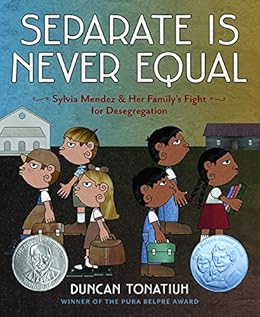
Separate is Never Equal ~ Using Diverse Picture Books

Image result for separate is never equal
Retrieved from Amazon.com
Separate is Never Equal: Sylvia Mendez & Her Family's Fight for Desegregation is a true story written and illustrated by Duncan Tonatiuh. The illustrations incorporate mixed media to enhance the depth of the images. Tonatiuh wrote that the book "is inspired by conversations I had with Sylvia Mendez in October 2012 and April 2013", and he utilized shortened dialogue from court transcripts to share an authentic retelling.

Brown vs. Board of Education of Topeka (1954) is often viewed as the landmark decision by the Supreme Court regarding segregation in public schools; however seven years prior to this Sylvia Mendez's family filed a law suit against Westminster School District of Orange County (California) to challenge remedial schools for Mexican students.

Sylvia Mendez offers this short interview regarding her experiences: 


Sylvia and her family had moved to Westminster, CA for her family to own a farm. As a 3rd grader, she was a US citizen and spoke English, but the closest school to their home would not allow her and her siblings to enroll. Instead, they were directed to a remedial Mexican school that had a less stable building, fewer academic supplies, less qualified teachers, and domestic curriculum. Sylvia's father advocated for his children to attend the school closer to their home by addressing various administrators, but to no avail. Eventually, he was advised to file a lawsuit. Here is a book trailer from Texas Bluebonnet Award:


This story is important to share with students who are learning about the Civil Rights Movement because it adds an additional perspective. Some students have a misconception that the Civil Rights Movement promoted equal rights for only Blacks, but there are also the marginalized voices of those who were considered lower class during that time period: Hispanics, Native Americans, and others. It is also important to share with students that this case would have provided a precedent for the Brown vs. Board of Education of Topeka. In this interview, Tonatiuh also explains that it's important to share this story because even though segregation is not allowed in public schools, there are still divides in education that make this story relevant. By sharing this book with students of all ages, we create an opportunity for students to not only learn a new perspective but also begin a dialogue of where they may see divisions in our education system.

Monday, July 8, 2019

Challenger Deep by Neal Shusterman : A VoiceThread Review

Less than two months ago, I had not heard of Neal Shusterman's novel Challenger Deep. Now I believe it is an important book to share with others! I even talked to my husband about it during our vacation, and he believes it should be made into a movie for others to hear this perspective on mental illness.

Rather than sharing a written review, I was pushed to create my first VoiceThread to review this novel for my critical literacy course. If you take the time to listen, I hope you will be intrigued enough to read Challenger Deep

Feel free to comment on my VoiceThread as well. I'm thinking VoiceThread might be a great way to record discussions for Literature Circles this upcoming year!

Friday, June 28, 2019

Dreamers ~ Utilizing Diverse Picture Books in English

This is my second children's picture book review related to my course through Hamline University in which we review and reflect on how to incorporate diverse texts into our curriculum. 

Cover retrieved from Amazon
Dreamers, written and illustrated by Yuyi Morales, is the story of a new mother with a young child immigrating from Mexico to the United States. The colors of the page hint at the mood and tone for the part of the journey that this mother and child are on, from understanding their thirst and hope as they arrive in a new city, to the color of the sky as they struggle with the language, and yet, colors of hope and the narrator's positive language stand out. The illustrations share unwritten experiences that are relatable (such as feeling lost while staring at a map) and entertaining (swimming in a city fountain). Despite the challenges of their travels, the baby boy and mother find a "home" in a public library where they discover picture books, their stories, and the dreams that they share.

One of the many beauties of this book is that Spanish vocabulary is interwoven within the story; this offers a small window into another culture with words of hope and journeys. The use of Spanish interwoven with touching images strengthens the authenticity of immigrant experiences. Morales' illustrations utilize multimedia from acrylic paintings to images of authentic clothing, drawings from her childhood and from her son, and photographs from her home in Mexico. These create not only beautiful artwork to mesmerize readers, but share an authenticity to the text. One could easily spend ten minutes on each page soaking in the artistic beauty, the symbolism, and unwritten details of the story. This makes Dreamers such a rich and engaging text beyond young children.

Here is an interview with the author and illustrator in which she shares her hopes and dreams in creating Dreamers:


Immigration is a frequent topic in today's news, and perhaps our students follow these stories, listen to the opinions told in their own homes, or choose to be ignorant. This exquisite picture book is appropriate to share with all ages to share a narrative of immigration that shares the hardships and the beauty of such a journey to becoming an immigrant to the U.S. What I would want to share with my students is Morales' immigration story at the end of the book; we could discover the similarities to her story, how she used her experiences to tell a story, and how she hopes others will share their stories. Teachers could introduce students to this as a companion text along with an informational article, a news story, or a novel based on immigration. For example, in my 8th grade English course, we read several articles related to immigration policies, both historical and modern, and MJ Auch's novel Ashes of Roses, which tells the story of an Irish immigration family in 1911. Dreamers would be an additional voice to add to an immigration story that is more contemporary and from another culture to help students discover the depth of stories and human experiences.

Sunday, June 16, 2019

Jingle Dancer ~ Utilizing Diverse Picture Books in English

I have begun a professional journey to earn my Master of Arts of Literacy Education through Hamline University. The current course has asked us to review three diverse children's picture books in the upcoming weeks. Though I do not consistently utilize picture books to make connections or as read alouds for my students, I am learning about the benefits of doing so. My hope in these reviews is to share with you books you may have not read and ideas how it could be incorporated in an ELA classroom.

Book cover retrieved from Amazon.com

Cynthia Leitich Smith's debut children's picture book Jingle Dancer was the result of her following the traditional writer's advice: Write what you know. Smith briefly shares this in the following Youtube video in which she introduces other books she has authored. She explains that in the late 1990's, she felt she best knew "contemporary mixed-blood families in the mid- to southwest." Beautifully illustrated in watercolor, the artistic pictures by Cornelius Van Wright and Ying-Hwa Hu bring the words to life with vivid colors and cultural details, such as the jingle dancers' regalia and jewelry with intricate beadwork.

Our protagonist Jenna daydreams of her grandmother's jingle dancing and admits to Grandma Wolfe that night that she would like to jingle dance. As most grandmother's do, Grandma Wolfe encourages Jenna to dance at the next powwow, but admits that they do not have time to order her own jingle tins. This encourages Jenna to visit her nearby family members in search of jingles while also indulging in cultural activities. While reading, the cultural background of Muscogee (Creek) Nation of Oklahoma reads with a genuine authenticity that gives the story a natural rhythm, much like we expect from dance music. The narrator describes the time of day "As Sun fetched morning," and Jenna enjoys fry bread, listens to a traditional story, and displays a focus on spending time with extended family, such as a great-aunt and cousin.

I was drawn to this particular story because of the title. My limited background knowledge reminded me that jingle dancing is part of Ojibway culture, and I have had previous students who dance at powwows in this style. Even though the inside jacket recommends this picture book for "Ages 4 to 10," this text could be paired with additional texts in upper grade levels, and I would especially recommend this for educators who teach in states with Ojibway/Chippewa/Anishinabe history. For example, this year 7th grade students had the option to read Louise Erdrich's The Birchbark House which is set in 1847; Jingle Dancer could provide a contemporary example of that historical culture. Senior high students in our district read excerpts from Anton Treuer's Everything You Wanted to Know About Indians but Were Afraid to Ask; these students could be asked to critically reflect on how cultural information is presented for very different audiences based on these two texts. These experiences provide additional windows and mirrors along with variety of story types and author purposes to critically explore.

Monday, January 21, 2019

Guitar Genius {reflection}

Our 7th grade class finished our Genius Project presentations before winter break, but we had one last blog post once they returned, a reflection. How do you think it went? Which projects were the most fascinating to learn about?

The very first presentation was my own! I demonstrated for the class as an example so that they knew what my expectations were. I shared what the goals were at the beginning of the project, where I found my research, what I learned, and demonstrated my new skills with three versions of "Rudolph the Red-nosed Reindeer": an acoustic, a rock preset, and a setting of my own.

Demonstrating a "rock" preset on my amp.

I had students recording presentations, so for future years I have both my own and student samples to share at the beginning of our project. This will help students to see the expectations for their presentations from the beginning.

Students had very positive comments about the project overall; many wished we could have continued throughout the winter break. I also had a few parents and even a community member compliment this research presentation.

The three favorite performances were:

  • Baking Holiday Treats (because they all had the opportunity to taste test)
  • Learning Unique Hair Braiding (they appreciated the presenters use of videos that were well edited)
  • Learning to be a Comedian (this student performed a short set within their project)
As a teaching staff, we plan to make a few improvements to the unit next year. Now we have videos to share, and we plan to have students create a works cited page (this year they created a list that sorted them by the source type).

Our blogs will continue to share our learning and progress throughout the rest of the year with other projects. We are especially excited to share Literature Circles with our students this spring.

Overall, Genius Projects have been deemed successful in developing student research skills, presentations abilities, and increasing their confidence! We plan to continue this project in 7th grade English for the foreseeable future.

Sunday, December 16, 2018

Guitar Genius {presentation}

We've made it to the final work days of our Genius Projects. For my guitar presentation, I have my introduction and research information prepared on Google Slides, will play a Christmas song with two different sounds thanks to my amp, and will end with a conclusion with helpful suggestions based off my own challenges throughout this project. This will require me to bring in my music, guitar, amp, and music stand.

I am feeling nervous about this presentation. Typically I am very comfortable with public speaking thanks to my previous speech experiences. I took two speech classes in college, so that helps. My most intimidating speech, though was at high school graduation. Another reason to feel comfortable is that we've been studying as a class for more than three months, so I know that my students are extremely respectful. This helps me feel more comfortable. To be honest though, I have not practiced as much as I should have these last four weeks, and now I am not as prepared as I should be. This makes me nervous of making mistakes when I play my song selection.

I hope you enjoy my Guitar Genius presentation this week!

Monday, December 10, 2018

{practicing} to be a Guitar Genius

This past week I have been working on the creation part of my Genius Project. This requires me to practice my song(s) that I will be performing with different sound settings to my class. I have been trying to complete most of my research during class and then practicing guitar three nights every week. Some weeks I have done a good job of practicing, but there was one night that I thought I was going to fall asleep with my guitar on my lap! So I went to bed instead.

I am finding that it's difficult to practice guitar on the nights that I have basketball games or late practice, but I also find that even though this is my homework, I enjoy this time and it's a relaxing part of my evening. My dog Chance is a little confused by what I'm doing. He stares at me, and occasionally barrels over to be pet when I pause between songs.

I have chosen to play a holiday tune because then students will be familiar. It is also practical for me! Christmas break is coming up and I will be able to play sing-along songs for my nieces and nephew now. I have been practicing two different songs since I haven't decided which to play. It'll either be a fingerstyle of "The First Noel" which is my personal favorite to play or "Rudolph the Red-Nosed Reindeer". This one would be fun to play with the rock-style settings on my amp!

Here is Carrie Underwood's version of "The First Noel".

I will NOT be singing when I present, but this is beautiful and for any students reading this before my performance, you may be able to sing along!

Just for fun, I found this rock version of "Rudolph the Red-Nosed Reindeer."


Deer students, please don't expect this kind of expertise from me.

I'm looking forward to preparing my presentation and performing next week already. Yikes!
Thanks again for following this Genius Journey!

Wednesday, December 5, 2018

Guitar Genius {research focus}

The first step I needed to accomplish was to dust off my guitar case and get this musical beauty set back up on it's rightful place on her stand. Yes, I personify my guitar. I spent 33 minutes searching through all the electronic cords in our house looking for the power cord and auxiliary cord to connect my Taylor T-5 to my Fender Mustang I amp. Guess where I found it... yeah, in my bag of guitar supplies.

Once I got my guitar unpacked and plugged in (which took 31 minutes longer than I expected), I had to tune my guitar. Despite being a recluse in it's case for over a year, it wasn't as out of tune as I expected. The first strum still made my ears burn, but it is relatively painless to correct. No, I cannot tune by ear. I can tell you when it's off, but don't have the skill to correct it.

Alright, power source ready, tuned guitar, and now it was time to warm up. Ay. Ay. Ay.

My fingers are out of shape! Compared to what I used to do, they are slow and I felt like I could only get them moving one tempo and trying to swing notes got me mixed up. However, I successfully made it through two warm-ups both with a pick and finger style.

After this warmup, I did my first research step: examined what I already know. While in college, I took a year of lessons, one semester with a small group and one semester private lessons. Luckily, since I was earning a minor, my program of study wasn't as intense as music majors. Did you know they practice THREE to FIVE hours EACH DAY?! Anyway, I started looking at all the scales and arpeggios I had memorized about six years ago, and yikes! I feel like I don't remember any of it anymore.
Copies of scales memorized while in college.

It's intimidating to feel like I've lost all of this knowledge and skill, but then I returned my thoughts to my goals of this project:

Short term: Learn the settings on my guitar and amp to create different sounds.
Long term: Feel comfortable to play at church.

This helped me narrow the focus of what research I need to do. I want to be able to play notes and chords at different speeds and create different sounds for different genres of music; I'm OK with not being able to improvise over a jazz piece. There's no reason to stress over my scale proficiency.

Now I've been working on learning and relearning settings on my guitar and amp.

This video has helped me understand my own guitar better:


This ten minute tutorial explains the different pickup settings on my guitar. I found it really helpful to set my amp on a neutral setting, watch the video, and pause and change the settings along with Corey Witt. These are sound changes I can adjust right on my guitar without changing the settings on my amp at all. Note, I have to connected to an amp for these, not playing my guitar acoustically.

There's a disc with settings that came with my amp and direction booklet for my amp, so I started looking into this but haven't done much with it yet. Turns out my amp has pre-programmed settings and then I can also create my own once I know what I'm doing.

This next week, I plan to pick out my song to play for students and to learn the settings that are on my amp.

Thanks for following my Guitar Genius Journey!


Monday, November 26, 2018

Becoming a Guitar Genius {one note at a time}

Genius Project is one of our major units in 7th grade, which is an adaptation of Genius Hour. Rather than focusing on one hour each week, we set aside 4-6 weeks for students to brainstorm, research, create, and present their own projects. This year we have decided to switch from keeping journals to writing blog posts, so I will model with my own! This first blog post is to describe what topic I have chosen and why.

This years Genius Project for me is to become a Guitar Genius! I admit, I have been playing guitar since I was 6 years old, but adulting has gotten in the way and I haven't played for a few years. Specifically, my short-term goal is to learn how to use my amp and it's settings to create different sounds. I also have the long-term goal to play in church when I'm more comfortable with these settings and back in a routine of practicing consistently.

My guitar {one of them actually}
 This is a Taylor T5, which I saved for one summer during college to buy.
If you ever buy a guitar or piano, go here: Carlson's Music World
Amazing service!!!
I miss playing my guitar! This is the most important reason why I chose this topic for my Genius Project. I fell in love with guitar at a young age and thankfully had supportive parents who arranged lessons for me, and I continued to use my guitar to help me earn a music minor in college. I have been meaning to be more consistent with practicing, and this project will help me do that! Another reason I chose this topic is because my music ability is not natural, but requires lots and lots of practice. I related with one of my colleagues when she said, "I can play notes, but playing and creating music is not my talent." I know that practicing will help me feel more comfortable.
My Mustang GT amp {I have very little idea how to use this}
For my creation I plan to learn a new song (maybe one my 7th graders will recognize?!) and play the chorus in a variety of settings on my amp. In four or five weeks, I don't think it's realistic for me to learn multiple songs with the settings on my amp. Perhaps my song will be a holiday tune with holiday break coming up. I know this part of my project may change as I research more information.

I hope you enjoy reading about my Guitar Genius Journey!


For any readers wondering, last year I modeled learning the basic skills of crocheting by creating a blanket for my car and have grown to making a triangular scarf. Here's the Pinterest inspiration of the scarf I'm currently working on: Caron Cakes Triangle Scarf

Saturday, November 3, 2018

Embracing an "Innovator's Mindset"

Back in July, our teacher book club tackled reading George Couros' The Innovator's Mindset

https://georgecouros.ca/blog/the-innovators-mindset-book

Though it's been a few months since I've read this book, it has been inspiring me throughout the first quarter of the school year, not with specific plans, but with the idea that it's not only "ok" to try something new, rather applauded and necessary! This is why I want to share my reflective takeaways of this book. 

George Couros has over 17 years of educational experience, and you can read about him here on his website. 

The back of this book advocates that any leader in a school will benefit from reading this book, and I definitely agree. In our book club, our principal joined us and he exclaimed that this book had him ready to go back to school and excited to make a difference. Teachers of any level or content will be encouraged from this book.

As a teacher, I felt that the messages were inspirational. It didn't necessarily spark specific lesson plans that I wanted to add to my curriculum (which is sometimes a relief!); however, it helped me see my current curriculum with new eyes to see which ways I have tried to innovate and those that will benefit from innovation.

It also had me thinking about what I have my students reading and writing in my class: "In our world today, what is a student more likely going to need to be able to write: an essay or a blog post?" One of my projects throughout the year is to have students read independent books, completely their choice: novels, nonfiction, chapter books, or short biographies--it's completely up to them, and I ask them to write reviews on Goodreads or our Google Classroom. However, this year I had them read a blog post from a writer about why they should write reviews and what they should you include. I'm wondering what other blog posts I could have them read before asking them to write one themselves...

Another recommendation from Couros that I want to embrace is collaboration. He explains the importance, "Innovation (and enjoyment) flourishes when teachers collaborate to learn and practice new strategies. Isolation is often the enemy of innovation." I have been in the position of being the only teacher of my grade level and now with shared classes, and there are many benefits to collaborating! Sometimes collaboration requires us to compromise, but our relationships grow stronger because of this.

Much more could be said about The Innovator's Mindset! If you're considering a teacher book club, this needs to be on your list. George Couros also has resources for you to use on his website


Tuesday, September 4, 2018

Speed Date {Books} on the First Day

Woohoo! School has arrived here in Minnesota, and I couldn't wait to share my classroom with students this morning. Not only did I have new flexible seating, but I completely changed my first day curriculum.
Flexible seating and books ready to be "dated."
I have used Book Speed Dating in my classroom before, but this is the first time on the FIRST day. Why the change?

I must admit, I saw Kelly Gallagher post the same idea on his Twitter, which was encouraging. I highly recommend following him!

As I was preparing my classroom, I asked myself what were my goals for the year. This is the first one I chose to display prominently:


I shared this goal with my students and I told them that we were going to start aiming for it right away.

To begin, I placed books from our classroom library throughout the room. I did my best to mix genres at each spot to offer variety.

When students came into the room, I explained my goal and why; then I shared their "golden ticket" with them. You can find a copy here.  


I demonstrated to the students how to review the books before deciding if the book was worthy of their "Want to Read" lists:
1. Switch seats when the timer buzzes--no jumping ahead; no staying behind.
2. Focus on your "date." Limit your talking.
3. Judge the cover.
4. Read the blurb and about the author.
5. Look at size: the number of pages, size of font, words per page.
6. Read the first 3 pages.
7. Decide if the book is worthy of your chart! (Not all books need to be on your chart)

This sheet guided them how to "date" their book and allowed them to record which books interested them and now they can save it to remind them which they may want to read later.

In my classroom, each "date" was 2:30 long. The timer was on the board to keep us all focused.

We continued for approximately 25 minutes. Then students completed the reflection "What types of books interest you? Explain why!" as a quick write, again with 2:30. I made a point to explain that this was an open-ended question and they could tell me about books they didn't enjoy, favorite books, etc. 

Then MY favorite part! I showed students how to utilize our classroom library, which has a simple checkout clipboard, return and repair bins. Students then checked books out!


So what's next? I'm planning several opportunities for students to share books.

One is this new bookcase display. Students will be recommending books to their classmates by decorating the spines of books. 


At the end of each quarter, students write book reviews online, either via Google Classroom or Goodreads to share their thoughts with their peers. 

And one still developing plan:


Reading and Writing Challenges! More to come later this year. 

I hope this inspires you to find ways to share books and reading with your students!
Happy school year!